The Vignettes and The Briefing
Building an editorial system around an
AI voice platform.
Words & Design
Michael Lang
Role
Founder, Designer, Creative Director
Year
2026
Client
Lyric Voices
Open Road. A vignette built around Morgan.
The composer answered a product question. The vignettes and the Briefing answered an editorial one.
Once the platform existed and the artists were on it, a new problem emerged. The category had been trained to talk about itself in the language of capability. Two million voices. Sub-second latency. Indistinguishable from real humans. Every competitor was selling the same specifications in the same vocabulary, and the buyer was being asked to evaluate voice the way you evaluate compute. The category had a marketing failure to match its design failure. Voices were being described as features.
I built the vignettes and the Briefing to refuse that frame, and to refuse it from two directions at once.
The vignettes are short films built around individual voices on the platform. Morgan, Nova, Atlas, Hex, Riven. Each one places a single voice in a context where it could plausibly belong. Open Road for Morgan as a Porsche film. Between Points for Nova as a tennis piece. The work is not a vehicle for the voice. The voice is a vehicle for the work. No on-screen explanation of how the platform functions, no mention of artists by name within the films, no competitive claims. The only branded element is the closing card, set in Cormorant Garamond, with the line Composed, not cloned. Everything before that point is the work. The argument arrives at the viewer through experience rather than persuasion.
The voice is a vehicle for the work.
Yoga by the Sea. A vignette built around Nova.
The Briefing is a daily AI news podcast narrated by Morgan, published every morning at six. It runs five days a week. It is not a demo. It is a real editorial product that has an audience, a release schedule, a Substack archive, and a Telegram distribution. Morgan has read it every morning for months. Listeners hear her voice before they hear most other voices in their day.
Two Sams. A vignette built around Morgan.
The two formats do different work and have to be understood together.
The vignettes are evidence. They show what a voice can carry when it's been built with care, in a single short, on a single subject. They function as demonstration through scene. A viewer who sees a vignette walks away knowing what Morgan sounds like in context, not as a sample on a feature page but as a presence in a piece of work.
The Briefing is endurance. It shows what a voice can carry when it's used every day, over months, across topics the writer couldn't have anticipated when the voice was recorded. The vignettes prove that a Lyric voice can hold a single scene. The Briefing proves it can hold a daily editorial product without fatiguing, without breaking, without becoming the wallpaper most synthetic voices become after a week. The two together make the case the category had stopped trying to make. That a voice can be both a performance and an instrument, and that the difference between those is whether someone built it on purpose with someone else.
Let's Vogue. A vignette built around Riven.
Each film places one voice in a world it could plausibly belong to, and lets the performance do the arguing.
Both surfaces also do work the composer cannot do alone. The composer is a tool. Tools are evaluated. The vignettes are evidence, and evidence is felt. The Briefing is presence, and presence accumulates. A user who works in the composer and then hears Morgan narrate the news the next morning has the platform's premise confirmed in a register the composer itself cannot reach. The three surfaces, composer, vignettes, and Briefing, point at each other. A new viewer can enter through any one of them and find the others. They are not a marketing funnel. They are three faces of the same argument.
The format itself is the moat.
Studio session. The work behind the voices.
The Briefing in particular is the surface that no competitor can replicate without rebuilding their entire model. A daily product narrated by a single named artist with an ongoing royalty relationship is structurally impossible on a platform with two million anonymous user-uploaded voices. Anyone who tries to copy it has to first do the work of treating a voice artist as a partner, which means they have to first stop being the kind of company they currently are.
What made this work, in the end, was committing to the editorial position the platform was built on. Lyric is not a synthesis utility. It is a venue where voice artists and writers compose together. That premise is the whole argument, and the vignettes and the Briefing are how I made it audible.
In the Edit
Every vignette and every episode of the Briefing is cut, graded, and finished by hand in Final Cut Pro. The craft is not outsourced. It is the argument.
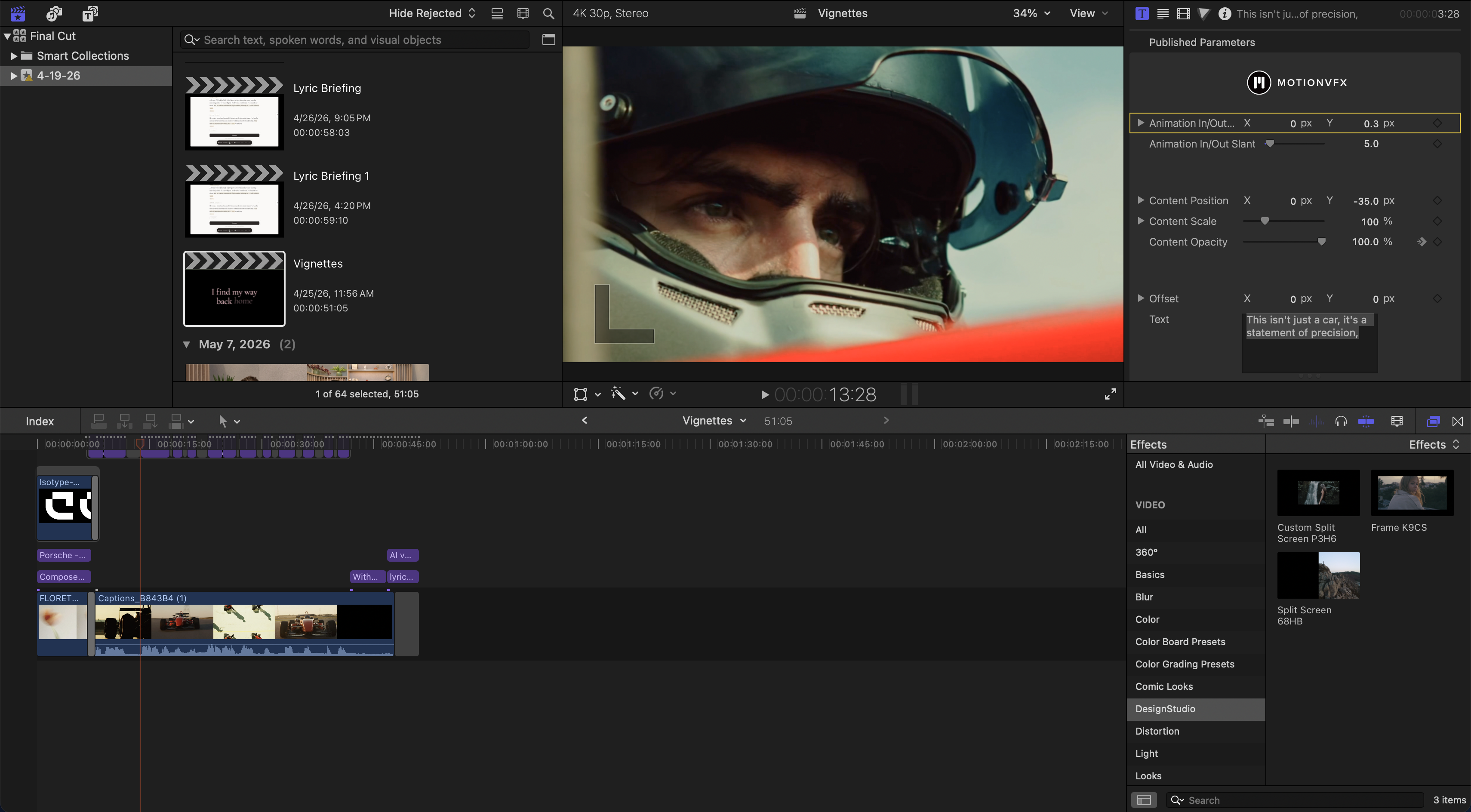
Cutting the F1 film in Final Cut Pro.
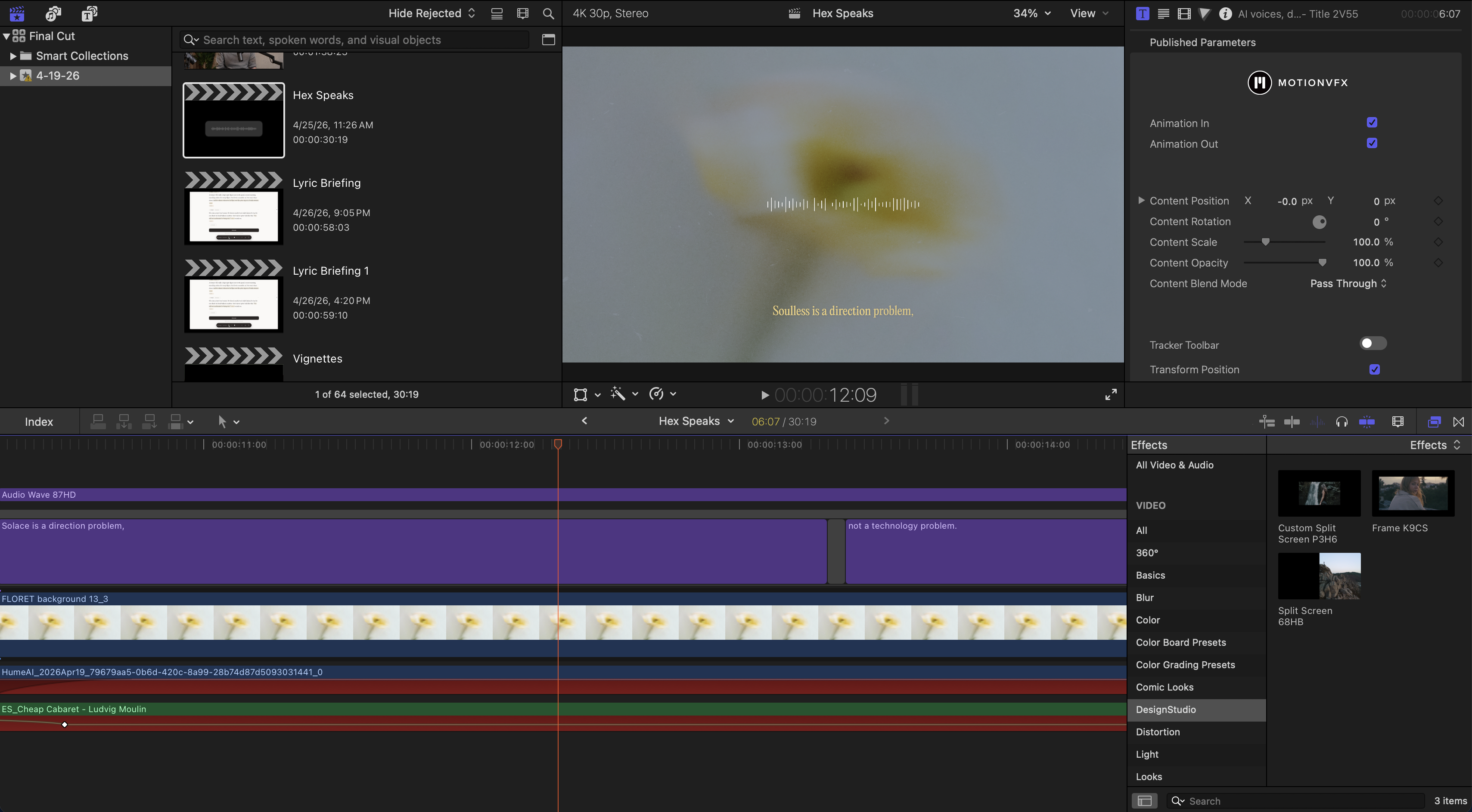
Color and titling on Hex Speaks.